
 TYSAS Desk
07, Oct 2026
20 min read
TYSAS Desk
07, Oct 2026
20 min read
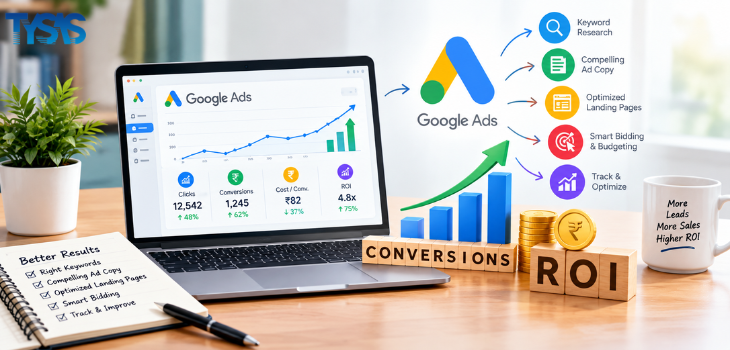
Google Ads(PPC) continues to be an important advertising platform for businesses that want to reach potential customers at right time. However, simply running ads does not guarantee more sales or a better return on investment. Businesses need the right strategy, relevant targeting, strong ad copy, and regular campaign optimization.
In 2026, Google Ads(PPC) is becoming more focused on automation, audience signals, AI-powered optimization, and conversion quality. Businesses that understand these changes can build campaigns that generate better leads and improve their advertising ROI.
In this blog, we will discuss practical Google Ads (PPC) strategies that businesses can use to increase conversions and get better results in 2026.
Before creating a Google Ads campaign, decide what you want campaign to achieve.
Your goal could be:
A clear conversion goal makes it easier to measure campaign performance. Instead of focusing only on clicks or impressions, you can understand whether your advertising is actually generating valuable business results.
Keyword selection remains an important part of Google Ads. Instead of targeting every keyword related to your business, focus on terms that show buying or enquiry intent.
For example, a website development company could target keywords such as:
These keywords are generally more commercially focused than broad informational searches.
Use different keyword themes for different campaigns and closely related ad groups. This can help make your ads more relevant to what users are searching for.
Negative keywords are often overlooked, but they can help prevent wasted advertising spend.
For example, if you provide paid website development services, you may not want your ads appearing for searches containing terms such as:
Right negative keyword strategy can reduce irrelevant clicks and help your budget focus on more relevant searches.
Review your search terms regularly and add irrelevant queries to your negative keyword list when appropriate.
Your advertisement is often first interaction a potential customer has with your business.
A good Google Ad should clearly communicate:
Instead of using generic statements, highlight specific benefits.
For example, instead of saying:
“Best Digital Marketing Services”
You could communicate something more useful:
“Grow Your Business With SEO & Google Ads”
Your ad copy should match the user's search intent and the service available on the landing page.
Getting clicks is only one part of Google Ads success. Your landing page needs to convert those visitors into leads or customers.
A good landing page should have:
If your advertisement promotes Google Ads management services, landing page should focus specifically on Google Ads services instead of sending users to a generic homepage.
A strong connection between keyword, ad, and landing page can create a better user experience.
Many users interact with businesses through smartphones. Therefore, your Google Ads campaigns and landing pages should work smoothly on mobile devices.
Check whether:
A mobile-friendly experience can make it easier for interested visitors to take action.
Without reliable conversion tracking, it becomes difficult to understand which campaigns are actually producing business results.
Depending on your business, you may want to track:
Conversion tracking allows you to compare campaigns based on meaningful outcomes rather than just clicks.
For lead-generation businesses, it is also useful to distinguish between a basic enquiry and a qualified lead whenever possible.
Google Ads provides automated bidding options designed to optimize campaigns toward specific goals.
Depending on your campaign and conversion data, strategies such as Maximize Conversions or Target CPA may be useful.
However, automation works best when Google receives reliable conversion signals. If conversion tracking is incorrect or the campaign has limited useful data, automated bidding may not produce the results you expect.
Do not simply activate automated bidding and leave the campaign untouched. Monitor performance and make adjustments based on actual business results.
One advertisement may not work equally well for every audience.
Test different versions of your headlines and descriptions. You can experiment with:
For example:
“Get a Professional Business Website”
and
“Build a Fast, Mobile-Friendly Business Website”
may attract different responses.
Testing helps you understand which messages connect better with your target customers.
Location targeting is particularly important for local businesses.
If your business only serves customers in specific cities, avoid spending your entire budget across a large geographical area without a clear reason.
For example, a business serving customers in Delhi and Noida may want to create location-focused campaigns rather than targeting the entire country.
You can also analyze campaign performance by location and adjust your strategy based on lead quality and conversion rates.
Not every visitor will become a customer during their first visit.
Some people may compare prices, research different companies, or simply need more time before making a decision.
Remarketing can help businesses reconnect with eligible previous visitors or audiences through Google Ads (PPC).
You can create campaigns designed to remind potential customers about your services, products, offers, or useful content.
The goal is not to repeatedly show the same advertisement to everyone. Instead, create relevant messaging based on the audience and their stage in the buying journey.
A campaign generating 100 leads may look better than a campaign generating 30 leads. But what if most of those 100 leads are irrelevant?
The number of leads alone does not tell the complete story.
Businesses should also monitor:
This approach helps you understand whether your Google Ads budget is actually contributing to business growth.
Google Ads should not be treated as a “set it and forget it” marketing channel.
Regularly review:
Pause or adjust elements that are consistently underperforming and invest more carefully in areas that produce valuable results.
Google Ads works even better when it is connected with other marketing activities.
For example, businesses can combine:
Someone may first discover your company through Google Ads, later visit your social media page, and eventually return through organic search before becoming a customer.
A connected marketing strategy can help businesses understand the complete customer journey.
Businesses often need more than just campaign setup. They need a complete strategy that connects advertising, website performance, SEO, landing pages, and lead management.
TYSAS provides digital marketing and website solutions designed to help businesses build a stronger online presence. From website design services and website development service to SEO, Google Ads, social media marketing, and lead-generation strategies, the focus should be on creating a practical digital marketing system around your business goals.
Google Ads in 2026 is not simply about spending more money or getting more clicks. The real focus should be on reaching the right audience, delivering a relevant message, improving the landing-page experience, and measuring the conversions that actually matter.
Businesses that combine accurate tracking, strong keywords, useful ad copy, optimized landing pages, smart targeting, and continuous testing can make better use of their advertising budget.
The most successful Google Ads strategy is one that is regularly reviewed and improved based on real business data. Start with clear goals, test different approaches, understand your audience, and focus on generating quality conversions rather than chasing clicks alone.







Lorem ipsum dolor, sit amet consectetur adipisicing elit. Molestiae modi impedit iure ducimus dolore eligendi provident praesentium nihil, nesciunt soluta.